Half-point moves paid, the longer holds gave it back
The morning's cleanest work was small and fast: a long in RKLB scaled out into strength, then a short back down off the top band for a defined half-point, with stops parked above the highs before the position was even full size. GOOG was the opposite story: one long worked well enough to scale, but repeated attempts to re-enter around VWAP and the previous day's close kept getting poked out, and AMZN never held a start at all. The desk broke slightly red, and the difference between the trades that paid and the ones that didn't was mostly how long they were asked to run.
The morning in figures
Net points are per share. Apply your own size to get your own number: at 1,000 shares, 0.53 points is −$530.00. At 100 shares it is −$53.00. At one share it is −$0.53. The desk publishes the move, not a dollar result, because the dollars depend entirely on how you size, and that is your decision rather than ours.
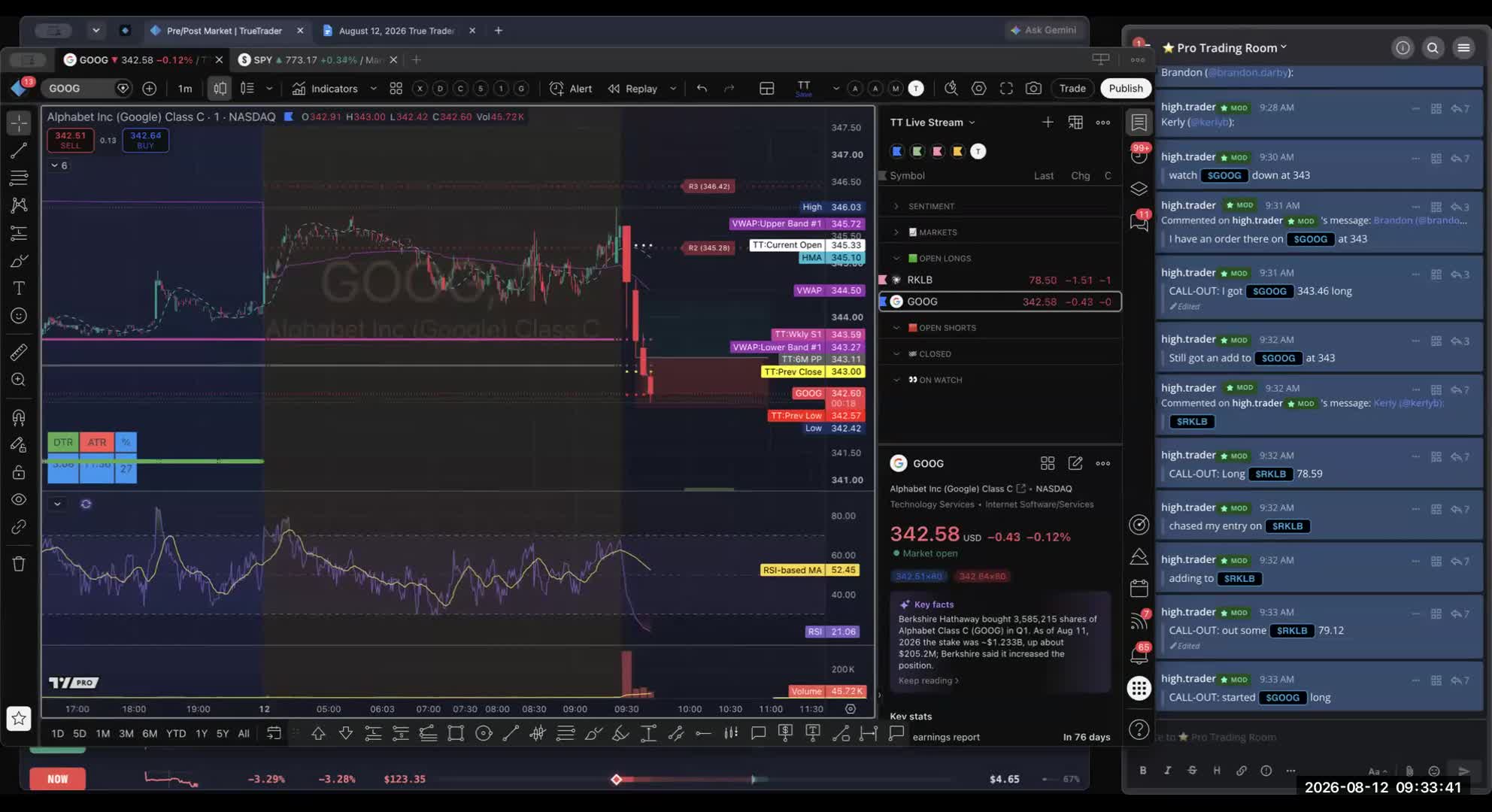
The 1h 08m session is on the other side of this.
Everything above is the write-up. This is the morning itself, with the names on every call and the room talking through it.
RKLB set the tone early. A long was started into the gap, added to at roughly the same average, and then scaled out in pieces on the way up rather than held for a number. When the same name pushed back into the top band an hour later, the short was taken with an explicit stated intent (half a point, stop above the highs), and it came out at half a point. Two trades, one name, both sides, neither one asked to do anything the tape hadn't already shown it could do.
GOOG was where the morning got expensive. A long was started under the previous day's close with an add planned lower, scaled at the average when it stalled, then stopped under the lows. It was re-entered on a spike back above that average and managed properly: stop lifted under a recent low, then to VWAP, then out at break-even when the five-minute broke lows. Later the same name was worked again from lower and that attempt paid a full point after a stop was missed by a cent. The last try was the costliest, and it was also the one taken with the least structure underneath it.
AMZN was two starts off the top band and premarket highs, both stopped within minutes, and the second stop was called out as a good one at the time. It was, the name kept going. Worth noting that a chase entry was owned out loud after the fact rather than quietly folded in. That habit is why the record is readable at all.
Every trade called that morning
Losers included. Rows with more than one leg were scaled out; open any row to see each exit.