Clean gap work early, then two names that kept crossing
The first hour was level work done the way it's drawn up: a gap fill scaled out in thirds, a chip name taken at a pre-marked level with the stop under the lows and trailed to break even, a mega-cap long worked off a level into VWAP, a short held through a full add, and a small-cap scaled cleanly. The damage came from two shorts in a name that kept crossing its own levels in both directions, and from a full-size semis long left to play out on a low-of-day stop after the room had closed. That last one was the single biggest hit of the morning and the reason the session finished red.
The morning in figures
Net points are per share. Apply your own size to get your own number: at 1,000 shares, 1.03 points is −$1,030.00. At 100 shares it is −$103.00. At one share it is −$1.03. The desk publishes the move, not a dollar result, because the dollars depend entirely on how you size, and that is your decision rather than ours.
The 1h 13m session is on the other side of this.
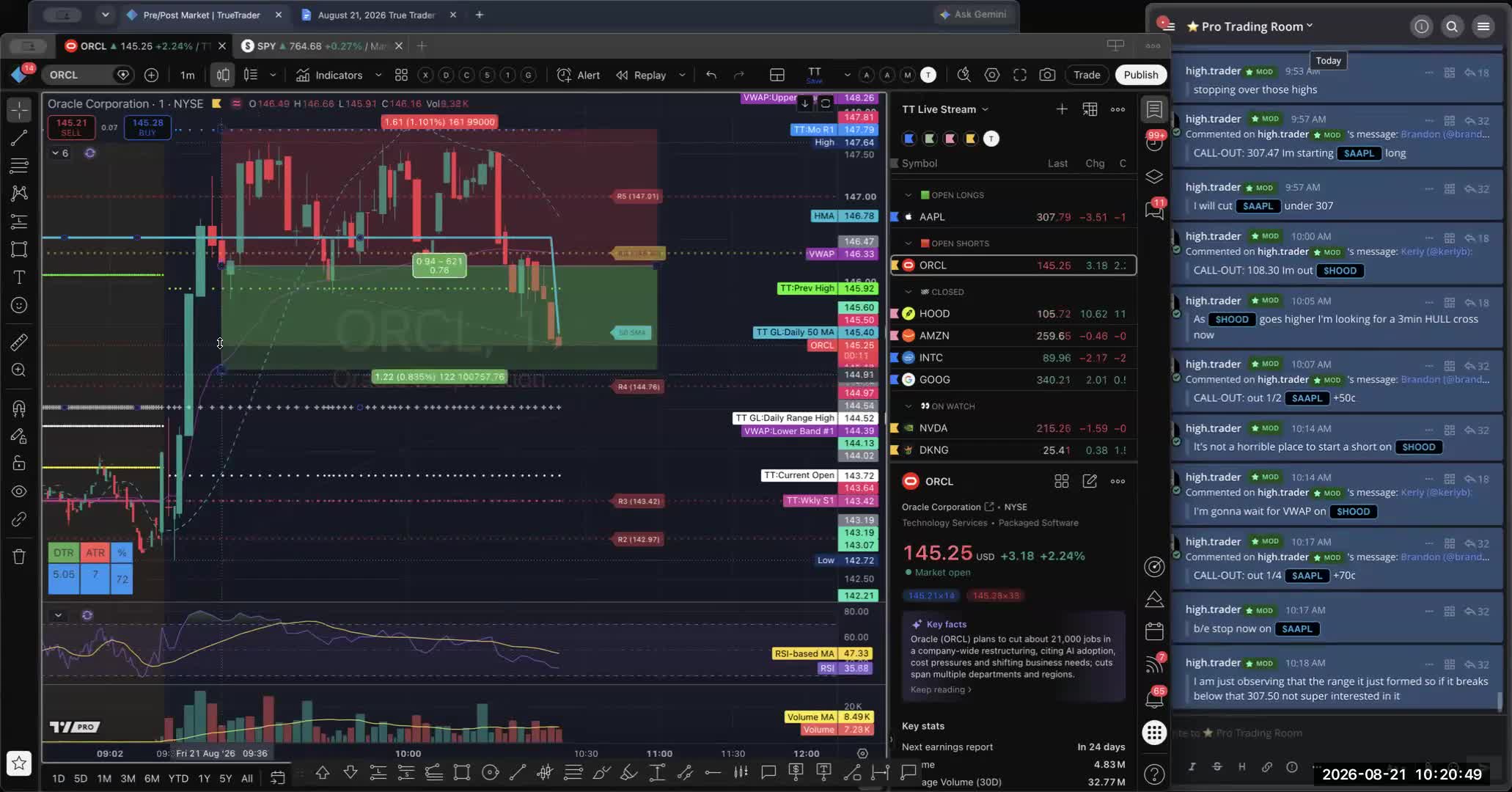
Everything above is the write-up. This is the morning itself, with the names on every call and the room talking through it.
Most of what got taken before the PMI print worked, and it worked because the entries were pre-marked rather than chased. The gap-fill long was started below the level and added into it, with the first third out almost immediately and the rest managed against the lows. The chip long was sized against a stop under the morning lows, quantified as risk before it was on, and then scaled in three pieces with the stop pulled to break even once there was room to VWAP. Nothing about either was clever; both were a level, a stop and a plan to take pieces off.
The AAPL sequence is the more interesting study. The first attempt was taken on a tight retrace because the risk was small, gave up half at target and then stopped under the lows for the rest. Rather than write the name off, the read was re-checked against the daily (higher highs, higher lows), and a second entry was taken on a new retrace, scaled twice and then stopped at break even when price touched the trail to the penny. Two tries, one flat-to-small and one genuinely constructive, because the risk on each was defined narrow enough that being wrong cost almost nothing.
The two shorts in HOOD are where the morning turned. The first was entered near the highs, stopped over a level, and cut with the honest admission that the better level was sitting just above and should have been waited for. The second was taken and then exited into the same two-way chop. After that, the decision was to skip re-entering and wait for a three-minute cross with enough distance to the next level to make it worth the risk. When that cross came without the room, it was passed on. That was the right call and it came two trades late. The MRVL long is the other lesson: full size, a low-of-day stop, no adds, and left to run past the close of the session. A plan that clear is fine; the size on a trade nobody is going to be sitting in front of is the part worth arguing with.
Every trade called that morning
Losers included. Rows with more than one leg were scaled out; open any row to see each exit.