A cool-down session, twenty-four hours before the Fed
The read going into the open was that nothing would hold a move ahead of the next day's rate decision, and the morning delivered exactly that: a tight range where a fifty-cent bounce had to be fought for. One Oracle long was worked patiently off the previous day's low, stop trailed up twice, and taken to target; everything else, including a thin-stock short and a late Amazon bounce attempt, was a paper cut taken at reduced size. The desk finished red, and did so having been told at the open not to expect anything.
The morning in figures
Net points are per share. Apply your own size to get your own number: at 1,000 shares, 1.28 points is −$1,280.00. At 100 shares it is −$128.00. At one share it is −$1.28. The desk publishes the move, not a dollar result, because the dollars depend entirely on how you size, and that is your decision rather than ours.
The 1h 12m session is on the other side of this.
Everything above is the write-up. This is the morning itself, with the names on every call and the room talking through it.
The open began with an explicit instruction to stand down: size small, expect pops to get sold, and treat anything in the middle of the range as no man's land. The morning then argued with nobody. Qualcomm was shorted into a thin breakout early on and stopped for the day's largest single loss. It is a name that suits a cross-and-go style but whose spread lets it jump a point against you before the idea has had a chance to be right.
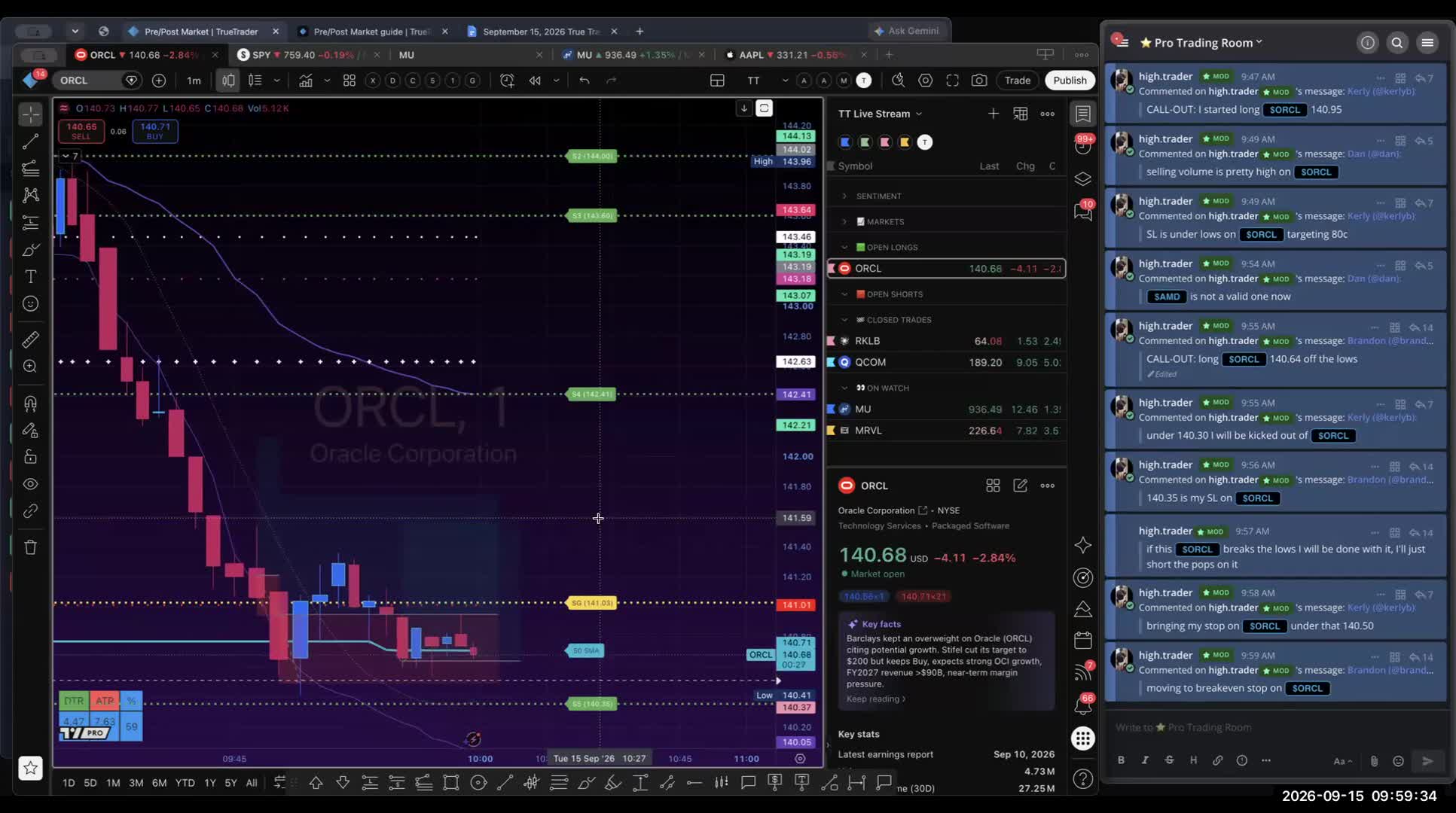
Oracle was the one setup that made sense to more than one person, and it was handled two different ways. One long was entered near the previous day's low with a defined stop under it, added to, then had that stop lifted twice as higher lows formed, and was carried to a pre-stated eighty-cent target and closed there. The other was a half-size entry on the same name, worked lower, that came within a cent or two of its first target twice without filling; the stop was moved to break even on the logic that a near-miss counts as a touch, and it got bottom-ticked out for nothing before the move resumed. That exact decision was interrogated on the desk afterwards: whether to split the stop, half at break even and half under the low. That is the more useful conversation than the outcome itself.
The last attempt was an Amazon long against a round number, taken and described in real time as a low-odds scalp: thirty cents of risk, tenth-size, entered knowing the index was rolling over and the setup would have been far better in the first five minutes than in the fortieth. It stopped quickly. A second, even smaller shot at the same idea did too. Nobody pretended either was a good trade going in, which is the point: they were priced as such.
Heard in the room
TrueTrader is a live trading desk: a group of traders working the market open out loud, every weekday. These are unedited captures from that room on this morning, in the order they were said.
On a quiet day sandwiched between two major market-moving events, Dan makes the case for sitting on your hands and saving your mental capital.
“So lot of trading is not giving it back.”
On a choppy pre-Fed day, Dan opens the room warning members not to force trades when nothing is worth taking.
“If it's not absolutely clear, it's not, it's also not worth taking.”
While reviewing a member's thin Qualcomm short that was breaking out against him, Dan pivots from the specific trade to a broader lesson about only taking trades where every nuance lines up.
“Many nuances have to line up to make sense to take the trade.”
Every trade called that morning
Losers included. Rows with more than one leg were scaled out; open any row to see each exit.