The first flush off the memory gap turned clean
China memory headlines gapped the chip complex down, and rather than buying the gap outright the desk waited for levels to come to it. Starter-size longs with tight defined stops, scaled out in thirds, the last piece trailed under the 50-day. Later attempts to buy the broader bounce were taken at reduced size with wider, pre-stated stops, and after the second failed attempt the desk stopped trying rather than pressing a read the tape had twice rejected.
The morning in figures
Net points are per share. Apply your own size to get your own number: at 1,000 shares, 5.29 points is −$5,290.00. At 100 shares it is −$529.00. At one share it is −$5.29. The desk publishes the move, not a dollar result, because the dollars depend entirely on how you size, and that is your decision rather than ours.
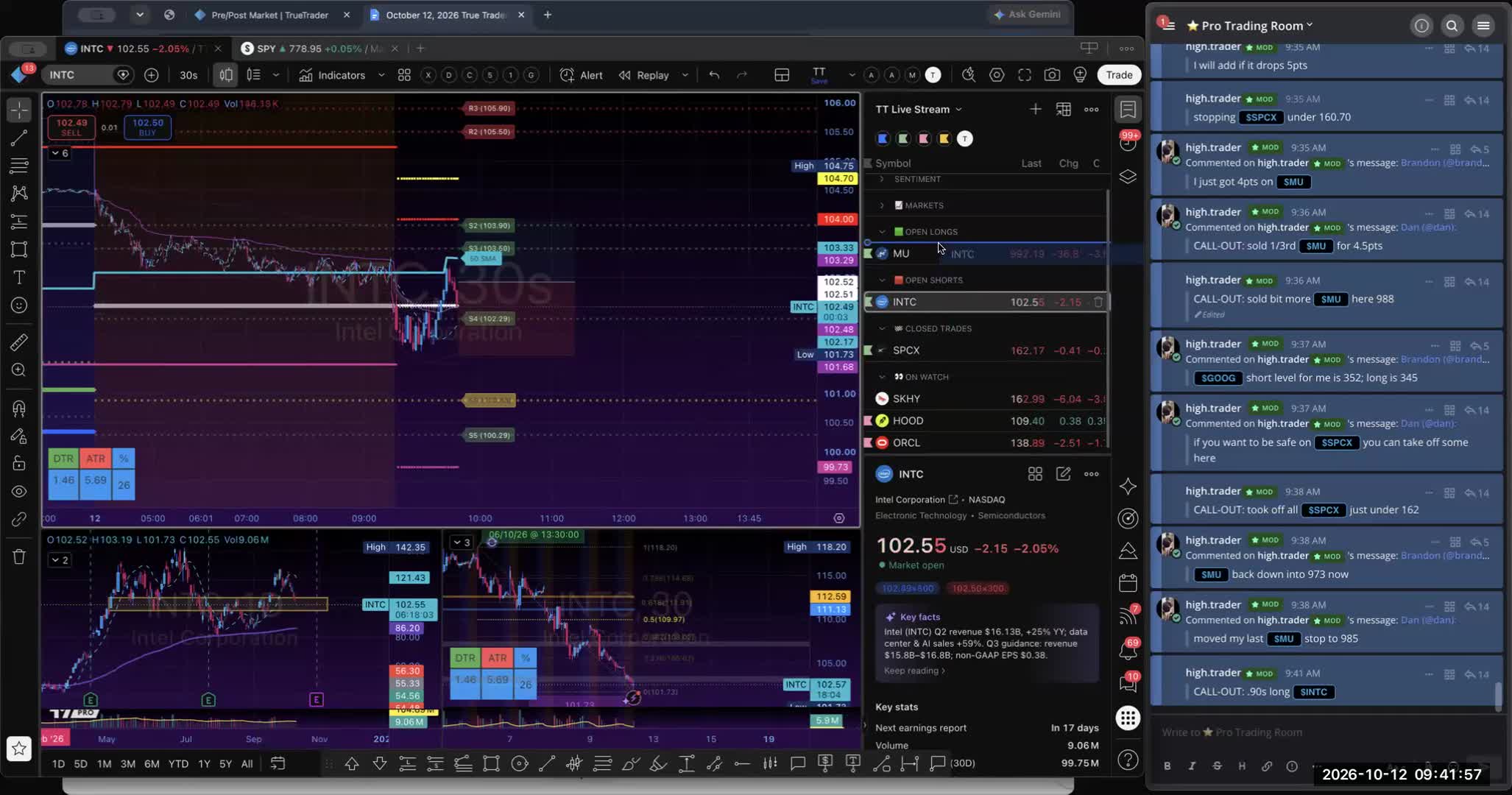
The 1h 09m session is on the other side of this.
Everything above is the write-up. This is the morning itself, with the names on every call and the room talking through it.
The morning's best work was done in the first twenty minutes and it was done by waiting. The gap-down was obvious and the temptation was to buy it outright; instead the levels were laid out premarket (short into the highs, long down at the 50-day) and the desk sat until price arrived. The space name was taken light with a one-point stop and the stop pulled up to the prior low once it moved; the first third came off for a few points, the rest went below the figure when it stopped holding there. Micron was bought on the curl off the 50-day using the low as risk, trimmed in pieces, with the last third trailed under the moving average. Neither was a hero-size position and neither needed to be.
The second half of the session was the attempt to buy the broader bounce, and it did not come. Intel was taken off the low of day with the size caveat said plainly (house money, wider stop, smaller size), and stopped at the lows exactly where it was planned to. SanDisk was tried off its own low with a ten-point stop after the Micron re-entry was missed, and it stopped too, with a fat-finger flip to short on the exit that got closed immediately. What mattered more than either loss was the reasoning afterward: two attempts at a reversal that hasn't come turns a good risk-reward idea into a low-expectancy one, so the attempts stopped and the desk went flat rather than paying for a third.
Elsewhere, Apple was worked half-size long with a VWAP stop and stopped out when VWAP gave way, Google was started half-size, added, cut, re-entered and traded break-even to small on a tape that kept missing fills by cents, and a Meta short was started against the highs with two planned adds and covered in thirds into VWAP. The through-line is that every position on the board had a stated stop before it had a profit.
Heard in the room
TrueTrader is a live trading desk — a group of traders working the market open out loud, every weekday. These are unedited captures from that room on this morning, in the order they were said.
Adri returns after a while away and begins setting up a story about an interview he saw with a man from South Africa who played arcade games as a teenager.
“And this is gonna resonate with a lot a lot of us, if not everybody.”
Adri tells the story of a tech CEO who revealed that the arcade racing game a man played for years as a kid had 90% fewer obstacles in the right lane — he just never noticed because he was chasing the action.
“Find something that is calm, simple, it can get you much further.”
Dan took two losing attempts at a market bounce and, instead of beating himself up, walks through why the risk-reward justified the trade even though it didn't work.
“I attempted and it's okay. That's all as long as the context is there.”
Every trade called that morning
Losers included. Rows with more than one leg were scaled out; open any row to see each exit.