Fear in the memory names, and a low that held
With memory gapping down hard and no obvious bottom in sight, the desk took the long side of MU deliberately small against the low of day, sized so the idea could be tried two or three times rather than once at full risk. That first attempt held, was scaled out in thirds and then trailed on a two-minute stop. A gap-to-close scalp in Apple, a Meta short below a defined level and a two-point-risk bid in the banks all paid; the Oracle shorts were the friction.
The morning in figures
Net points are per share. Apply your own size to get your own number: at 1,000 shares, 15.89 points is $15,890.00. At 100 shares it is $1,589.00. At one share it is $15.89. The desk publishes the move, not a dollar result, because the dollars depend entirely on how you size, and that is your decision rather than ours.
The 1h 07m session is on the other side of this.
Everything above is the write-up. This is the morning itself, with the names on every call and the room talking through it.
The question all morning was whether anything had stopped going down. Memory was capping five and a half percent lower and the honest answer from the desk was that nobody knew where the bottom was, so the first MU long was taken against the low of day at a fraction of normal size, with the stated plan of spending that risk over two or three attempts. It nearly got stopped on the first push, then broke the high of day, and from there it was managed rather than hoped on: a third off into the first extension, a trailing two-minute stop, another third into strength, the last piece held with the stop moved up in steps and finally taken when the name double-topped and pulled back. Not the top tick, and said as much out loud.
The cleanest work was elsewhere. An Apple gap-to-close scalp was closed quickly when the failed breakout and shallow bounce argued against a second helping. The setup was named, the re-entry was priced, and it was passed on because the context had turned. Meta was flagged below a level by someone who does not trade it and taken by someone who does, with a defined two-and-a-half point stop and halves out on the way up. The bank retrace was a two-point risk bid in JPM ahead of a three-to-five point retrace, scaled in thirds, with the remainder cut when the stock built a new base and the reward against the fresh stop no longer justified holding.
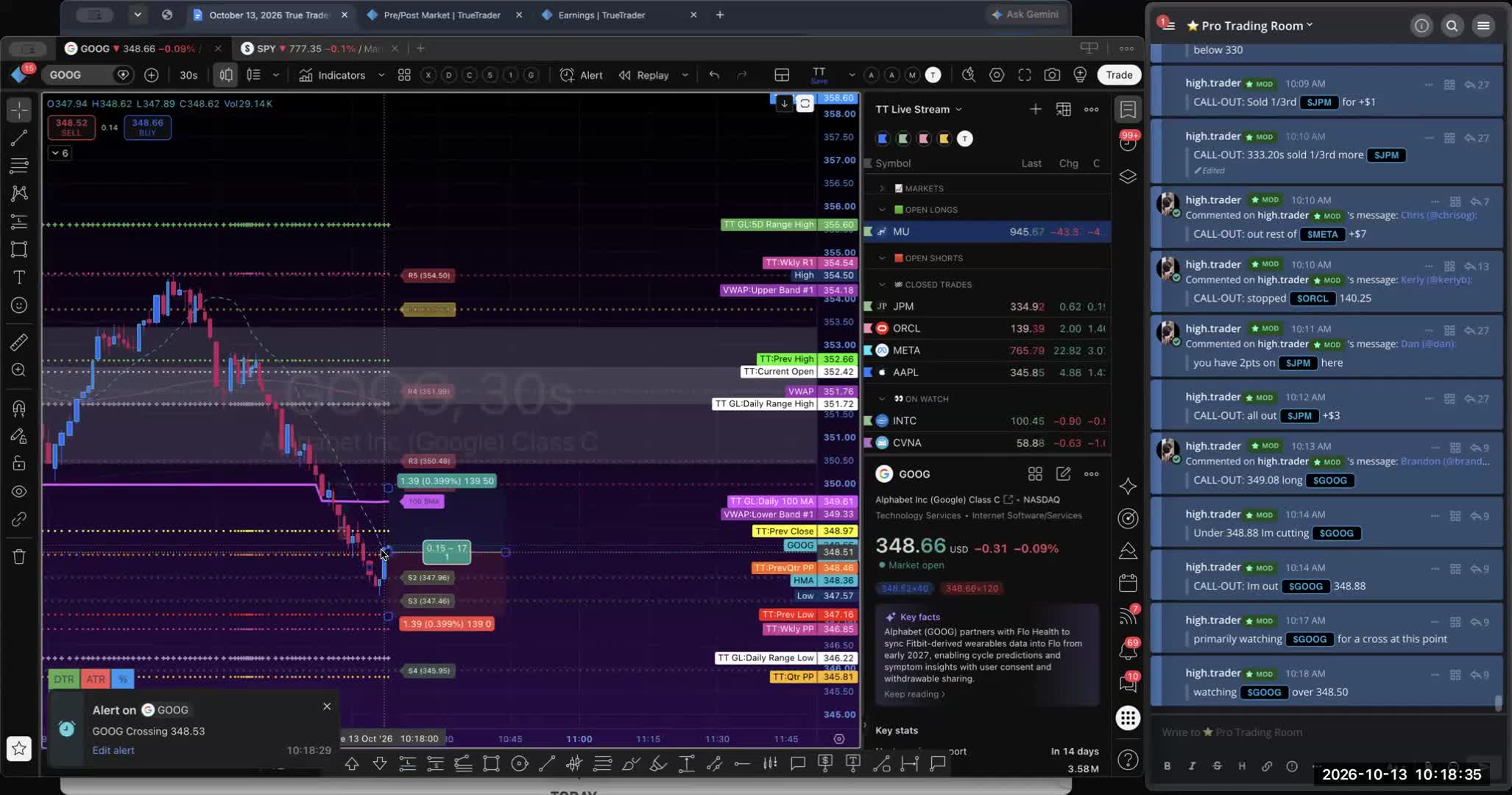
Oracle was where the morning fought. The short was taken without sizing for an add, by design, so the stop was simply a stop; it was taken, re-entered, part-covered on the break, and the second attempt was stopped out again in what got called a washing machine. Google was similar in shape: the first gap-to-close long got flushed, the re-attempt went on at half size with a planned add into the retest and a stop under the lows, and it was closed for a small gain by someone who did not like what the tape was doing with it. Both are the same discipline that made MU work, just applied to ideas that did not pay.
Heard in the room
TrueTrader is a live trading desk — a group of traders working the market open out loud, every weekday. These are unedited captures from that room on this morning, in the order they were said.
A member named Don took a first loss, then stayed flexible and re-entered to make 5.5x that loss on NQ — Adri uses it to drive home that a stop isn't a personal failure.
“Just remember when you're trade never, it's never, never, never personal.”
Every trade called that morning
Losers included. Rows with more than one leg were scaled out; open any row to see each exit.