Sympathy Stocks: How to Trade a Move That Started Somewhere Else
On 19 December 2022, Madrigal Pharmaceuticals closed up 268% after its Phase 3 MAESTRO-NASH trial hit its endpoints. If you were watching only MDGL that morning, you saw one enormous move and no way to participate in it, because the stock gapped far beyond any sane entry before most people had finished reading the headline.
The traders who made money on that news mostly were not in MDGL. They were in the other liver-disease names.
That is a sympathy move: a stock that runs because something happened to a different stock. It is one of the few edges available to a retail trader that does not require faster data or a better fill than everyone else, because it takes the market a few minutes to work out which companies the news actually touches. Those few minutes are the entire opportunity.
Here is what that morning actually looked like. Madrigal opened 218% higher and finished the day up 268%. Viking Therapeutics, developing a drug in the same class and with no news of its own, opened 42% higher and closed up 82%, running harder after the open than at it. Terns Pharmaceuticals opened 32% higher. And Akero Therapeutics, whose competing programme had just been beaten to a positive readout, opened 21% lower and closed down 17%.
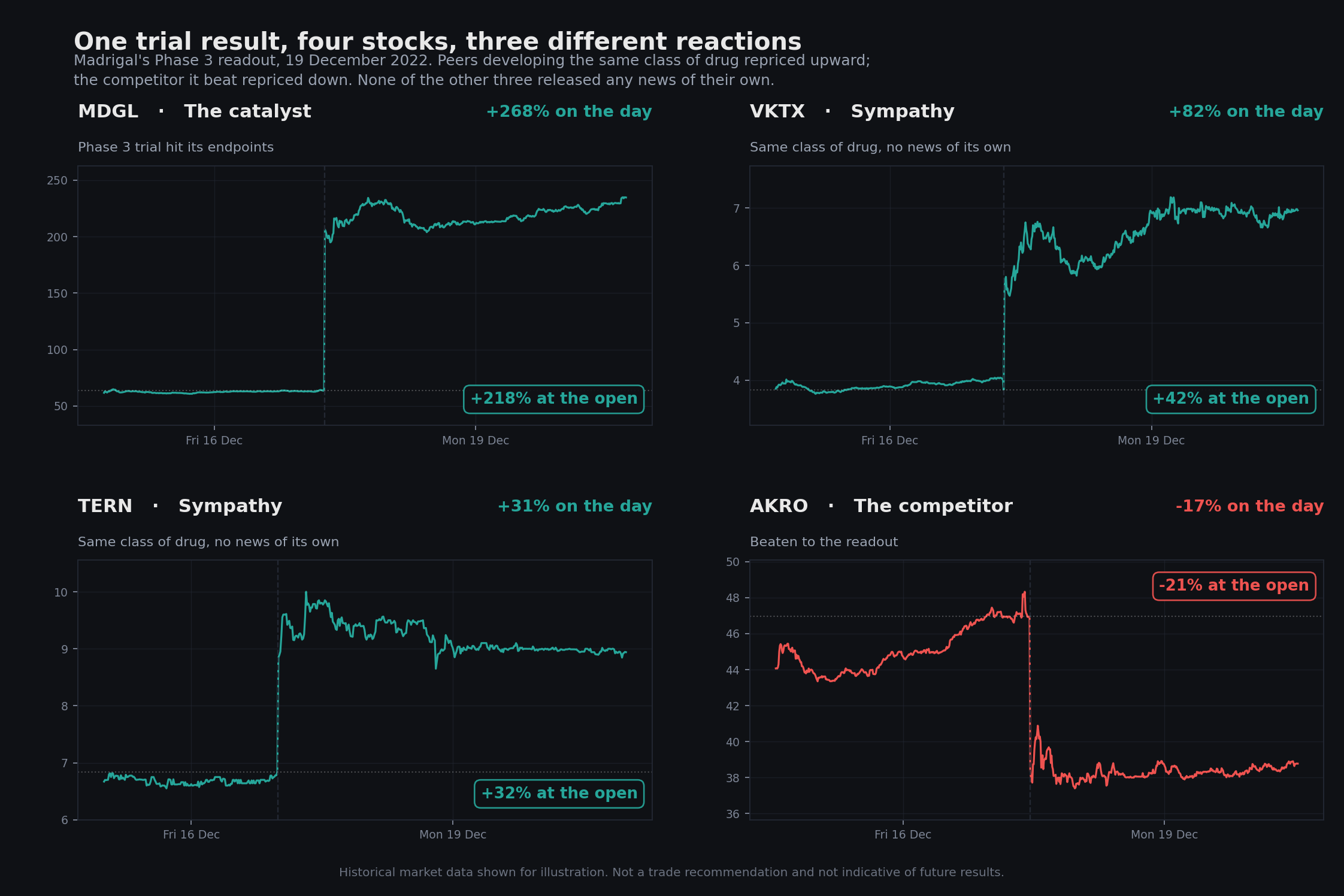
Three things in that picture are worth sitting with. The sympathy names moved a long way on somebody else's news. The size of each move tracked how directly the news touched that company rather than how big the company was. And one of the four went down, which is the case people miss.
Why sympathy moves happen at all
A stock reprices when the market learns something about its future cash flows. Sometimes that news arrives about the company itself. Often it arrives about a company next to it, and the read-across is real.
Three mechanisms account for most of what you will see:
Shared science or shared demand. When one drug in a class works, every company developing a drug in that class becomes more likely to work too, and the market marks them up before anyone has run a new trial. The same logic runs through semiconductors, where one company's order book tells you about the whole supply chain.
Competitive displacement. The mirror image, and the one people forget. If a rival just proved a treatment works years ahead of your timeline, your company is now behind. Good news for one name is frequently bad news for the company chasing it, and those stocks fall on a day the sector is green.
Mechanical flows. Index and sector ETFs hold baskets. Money moving into a theme buys everything in the basket, including names with no genuine exposure to the news. This is the weakest form of sympathy and the one that fades fastest.
Knowing which of the three you are looking at matters more than spotting the move. The first two can hold for days. The third often gives everything back by lunchtime.
Where to look
Direct competitors
Start with the obvious one and be careful about direction. Two companies competing for the same market do not always move together. When the news is about the size of the market, they rise together. When the news is about who wins that market, one rises and the other falls. Read the headline for which question it answered.
The supply chain
A large company's results are a report card on its suppliers. Apple's unit volumes tell you something about the firms making its components, and those suppliers are often smaller and more volatile, so the same information moves them further. The work here is done in advance, not in the moment. Knowing who supplies whom is research you do on a quiet weekend, and it is what lets you act in the ninety seconds when it pays.
The sector
Sector ETFs are a fast way to see whether a move is about one company or about everything it sits with. If the sector ETF is flat while one name is up 12%, the story is company-specific and sympathy plays are thin. If the ETF is moving too, the read-across is being priced across the board.
Macro
Rate decisions, inflation prints and jobs numbers move whole groups of stocks at once, through duration and cost of capital rather than through any company-specific fact. Unprofitable growth names and rate-sensitive sectors respond hardest. This is sympathy at the widest scale, and it is the version where you should be most suspicious of a tidy backtest, because there are only a handful of these events a year and it is very easy to find a pattern in a sample that small.
What usually goes wrong
The concept is easy and the execution is where accounts get hurt. Four failures show up repeatedly.
You are late and you size like you are early. By the time a sympathy name is obviously running, the risk is no longer at the level that justified the trade. The move has already happened. Chasing it means your stop is now much further away, and if you keep your usual share size, you have quietly taken several times your normal risk.
The relationship is a coincidence. Two stocks moving together for a month is not evidence of anything. Sector membership is not a mechanism. Before you trade a pair, you should be able to say in one sentence why the news changes the second company's future, and if you cannot, you are trading a correlation that has no reason to persist.
The liquidity is not there. Second-order names are usually smaller. A stock that trades 400,000 shares on a normal day, running on somebody else's news, can have a spread several times its usual width exactly when you want out. The chart shows a clean move. Your fills will not be clean.
You are holding it overnight. Sympathy is a reaction to information, and information gets absorbed. A name that ran purely because its neighbour ran has no independent reason to keep going the next morning, and it carries full gap risk while you find out.
How we actually use it
On our desk, sympathy is a way of building a watchlist, not a signal on its own. When a catalyst lands, the question is which names it genuinely touches, and that list is drawn before the open rather than typed into a scanner while the move is happening.
From there it is an ordinary trade with ordinary rules. There has to be a level worth trading against, the risk has to be defined by where the idea is wrong rather than by how much we want to make, and the size comes from that distance. A sympathy move with no structure to trade against is a story, not a setup.
The honest limitation is that none of this can be automated into a rule you follow blindly. Deciding whether a piece of news genuinely reads across to another company is a judgement, it depends on the specific facts, and it is the part that takes the longest to learn. Watching somebody make that call out loud, in the minutes while it matters, is considerably faster than reading about it.